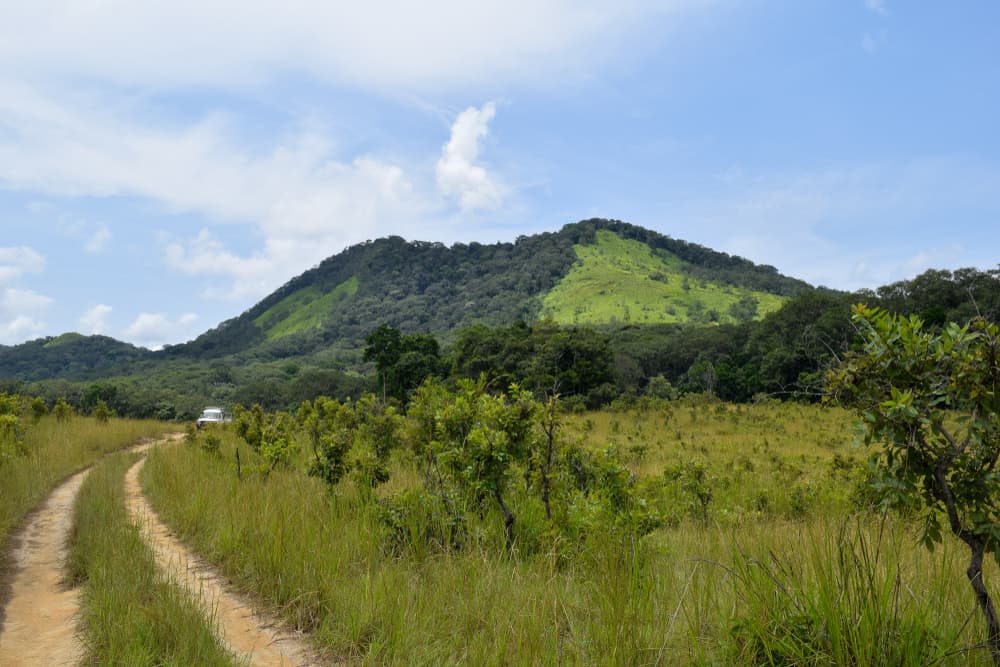
Lopé National Park
Lopé National Park
In the heart of Gabon, Lopé National Park covers approximately 4,970 km² of equatorial forest and relict savannas.
In the heart of Gabon, Lopé National Park covers approximately 4,970 km² of equatorial forest and relict savannas. Inscribed on the UNESCO World Heritage List since 2007, it is home to one of Africa's largest populations of western lowland gorillas and Central African chimpanzees. The meeting point between dense forest and ancient savanna makes it an exceptional site for wildlife observation and the study of tropical ecology.
Practical Information at a Glance
Admission: Fee-based — permits issued by the National Agency for National Parks (ANPN)
Access: Libreville–Lopé train (Transgabonaise line) or road from Libreville (~300 km)
Recommended duration: 2 to 4 days minimum to observe wildlife and explore different habitats
Clothing: Covering garments, neutral colours, waterproof hiking shoes
Mandatory guides: All forest or savanna outings must be accompanied by an ANPN-approved eco-guide
What to See
Lopé is one of the rare places in the world where tropical forest and savanna coexist side by side. The relict savannas, remnants of the last glacial period, offer open vistas rarely seen in Gabon. Wildlife is abundant: western lowland gorillas, chimpanzees, forest elephants, buffalo, sitatunga, and a rich avifauna exceeding 400 recorded species.
History and Context
The Lopé region has been inhabited since prehistoric times. Rock engravings and archaeological sites testify to ancient human occupation, notably by the Kota and Fang peoples. The area was classified as a wildlife reserve in 1946, then elevated to national park status in 2002. In 2007, UNESCO inscribed it on the World Heritage List for its exceptional natural and cultural value.
Highlights of Your Visit
Gorilla and Chimpanzee Observation
Groups of western lowland gorillas have been habituated to human presence, allowing guided on-foot approaches. Outings take place early in the morning. Patience is essential: observations are never guaranteed.
Relict Savannas
These unique open grasslands in the Congo Basin allow you to observe elephants and buffalo in daylight. The striking visual contrast with the surrounding dense forest enhances wildlife observation from a distance.
Rock Engravings
Several archaeological sites preserve rock engravings dating back several millennia. Accessible with a guide, they add a rare cultural and historical dimension to an African natural park.
The Ogooué River
The Ogooué River borders the park and forms a major biodiversity corridor. Canoe outings allow you to observe hippopotamuses, crocodiles and waterbirds in an intact forest setting.
Photography Tips
Light in dense forest is low: opt for a bright lens (f/2.8 or less) and high ISO sensitivity. In savanna, the first hours after sunrise offer ideal golden light. When approaching great apes, guides enforce a minimum distance—do not attempt to get closer for a better composition. Drones are prohibited in the park.
Location and Access
The park is located in Moyen-Ogooué province, approximately 300 km east of Libreville. The Transgabonaise train connects Libreville to Lopé station, the main park entrance. The road is passable by 4×4, especially during the dry season. Lopé Lodge, situated on the park's edge, serves as the main logistical base for visitors. All activities are organized through ANPN or approved lodges.
Nearby Attractions
Libreville — Gabon's capital and departure point for reaching Lopé by train or car.
Waka Reserve — neighbouring national park, less visited, for an even wilder immersion in equatorial forest.
Ivindo National Park — home to Kongou Falls, one of Central Africa's largest waterfalls.
Frequently Asked Questions
Frequently asked questions
The dry season (June to September) is most favourable: tracks are passable, less dense vegetation facilitates wildlife observation, and animals concentrate near water sources. The major rainy season (October to December) makes certain areas inaccessible.
Yes, all forest or savanna activities must be accompanied by an eco-guide approved by ANPN. It is not possible to explore outside the lodge's designated areas on your own.
The Transgabonaise train is the most practical and commonly used option. It connects Libreville to Lopé station in several hours. The 4×4 road route is possible but longer and depends on track conditions according to the season.
No. Even with habituated groups, gorillas remain wild animals whose movements are unpredictable. Experienced guides maximise chances, but no observation is guaranteed.
Two days is a minimum to combine a gorilla outing, savanna walk and Ogooué excursion. Four days allows you to explore archaeological sites and increase chances of wildlife sightings.
No. Drone use is prohibited throughout Lopé National Park, particularly to avoid disturbing wildlife.
Interested in this visit?
We can include it in your personalised itinerary.